
The world is watching the Artemis II launch. If you look up at the night sky this week, you will know local students are tracking the spacecraft orbiting the moon. Five university students right here in New Brunswick are keeping a close eye on the mission. According to Global News, the University of New Brunswick is the only academic institution in Canada tracking the Orion spacecraft alongside NASA.
The 10 day mission began Wednesday evening when the Orion crew lifted off from the Kennedy Space Center in Florida. The spacecraft carries NASA astronauts and Canadian Jeremy Hansen on a trajectory around the moon. This marks the first crewed mission to the moon since 1972.
In Fredericton, UNB electrical and computer engineering professor Brent Petersen and his students will soon learn if their months of preparation paid off.
“It will be encouraging to have the students involved and participate in this. Didn’t expect I’d be here one year ago,” Petersen said.
The New Brunswick group joins 34 companies, space agencies, individuals and universities around the world officially tracking the mission. This volunteer program allows them to complement the data NASA gathers. The space agency uses this information to better understand the tracking capabilities of the broader aerospace community.
Tracking Orion from Gillin Hall
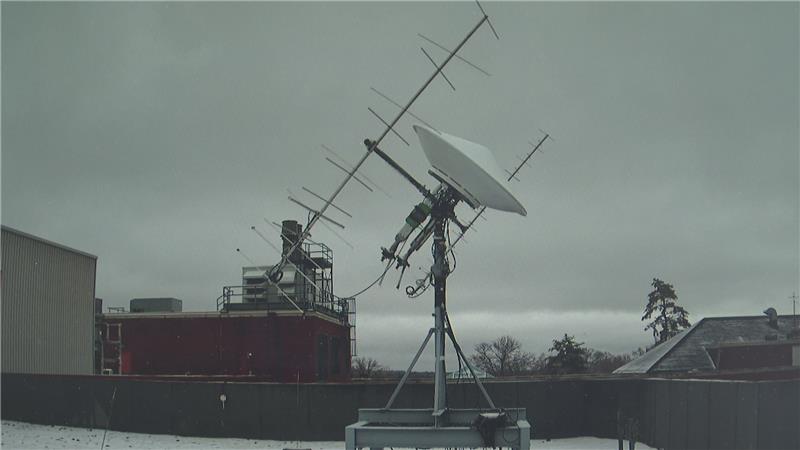
Petersen and his students use their satellite dish at the UNB Earth Station atop Gillin Hall to track the spacecraft. They save data on computers for later analysis and monitor where signals originate.
“In fact, NASA would like the data to be uploaded as soon as possible. At least every day because that might give them information they’re looking for,” Petersen said. He noted NASA is highly interested in the date, time and frequency of the received signals.
The UNB Earth Station was never designed for deep space. However, it successfully picked up signals from the James Webb Space Telescope located about 1.5 million kilometers from Earth.
“The moon is only 300,000 km from Earth’s surface so it bodes well for our Earth Station being able to pick up signals from Artemis II,” Petersen said.
Students Launch Aerospace Careers
The university selected students with amateur radio licenses for this project. They spent eight months working on the technical aspects of tracking Orion.
“I’m in my last year, so I’m taking every opportunity, getting my foot in the door, in the space industry and actually being part of a real space mission,” said Olivia Ferry Rice, a sixth year software engineering student.
Chris Carson, a fourth year electrical engineering student, shares the dream of building a career in space.
“I would love to go into a career in space, and mix that with what I’ve been learning in school,” Carson said. “It’s nice to be able to help out with NASA and to be able to contribute to a real moon mission.”
Petersen finds the experience exhilarating. He recognizes the important role his team plays in this historic mission.
“I feel like I’m a student again because I’m working hard to try and put everything in place and help everybody, and it’s like NASA will be grading me,” he said.
Frequently Asked Questions
What is the Artemis II mission?
Artemis II is a 10 day crewed mission to the moon. It is the first crewed lunar mission since 1972 and includes Canadian astronaut Jeremy Hansen.
Why is the University of New Brunswick involved?
UNB is the only academic institution in Canada officially tracking the Orion spacecraft. They are part of a global network of 34 entities providing tracking data to NASA.
How do the students track the spacecraft?
The students use a satellite dish located at the UNB Earth Station on top of Gillin Hall in Fredericton. They record the date, time and frequency of signals received from Orion.


0 Comments